The 16-year-old American is not merely changing hands—he is challenging one of tennis’s oldest technical assumptions
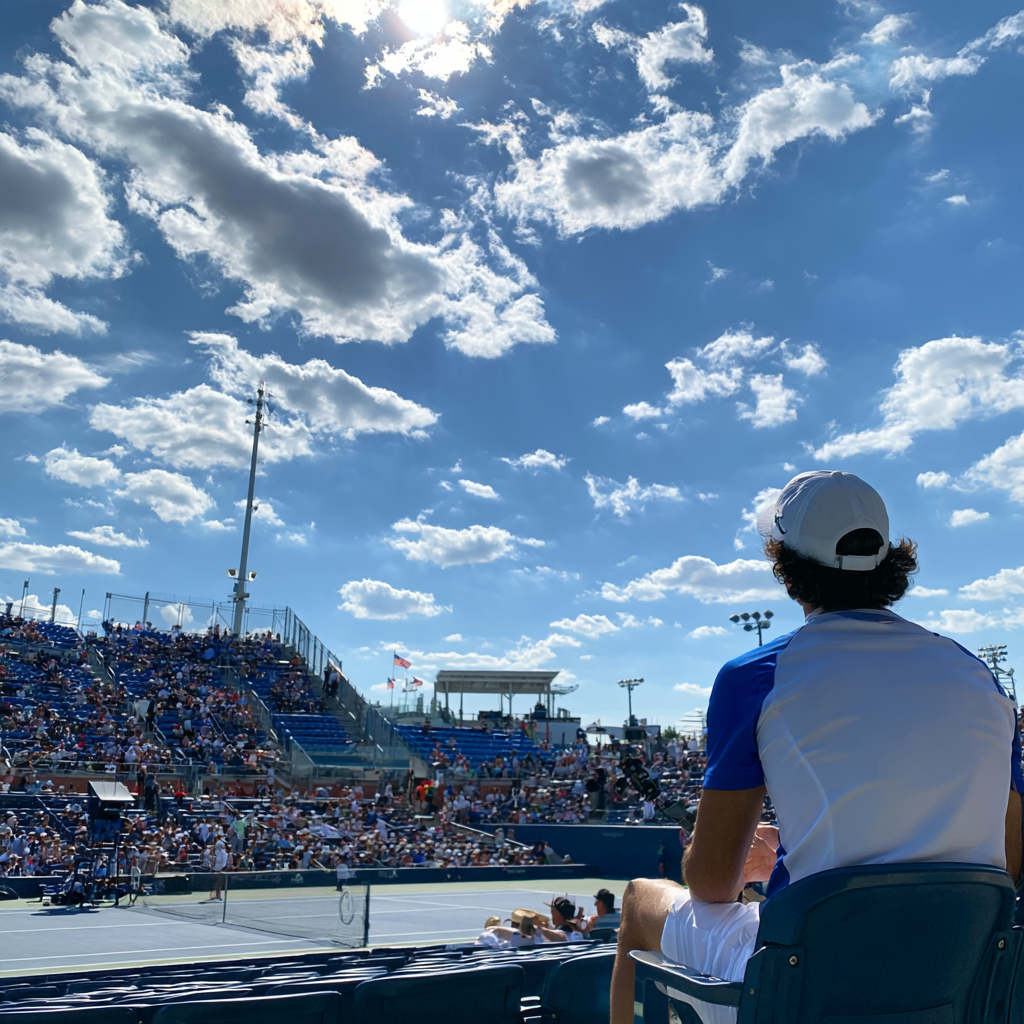
Teodor “Teo” Davidov walked onto Court 6 at the 2026 US Open Junior Championships carrying one of the most fascinating experiments in modern tennis.
He did not arrive with a new racquet, revolutionary string technology or unusual grip. His difference was more fundamental: Davidov plays without using a conventional backhand.
When the ball travels to his right side, he hits a right-handed forehand. When it travels to his left, he transfers the racquet and hits a left-handed forehand. He can also serve with either arm, giving opponents different spins, trajectories and visual patterns to interpret.
Davidov lost his opening junior singles match to South Africa’s Connor Doig 7-6(4), 6-3. The result ended his singles run, but it did not diminish the importance of his appearance.
At only 16, Davidov is attempting something much larger than winning one junior match. He is testing whether one of tennis’s most accepted technical structures—the forehand on one side and backhand on the other—is an unavoidable solution or simply the solution players have traditionally inherited.
“Innovation often looks unusual before it begins to look inevitable.”
The Player With No Backhand
The description is memorable, but not completely literal.
Davidov is capable of hitting a backhand. Earlier accounts of his development indicate that he learned conventional one-handed and two-handed backhands. He and his father-coach, Kalin Davidov, made a deliberate choice to construct his competitive identity around two forehands.
Teo is naturally right-handed. When he was approaching eight years old, his father began encouraging him to play left-handed as part of a broader philosophy of physical balance and development. What started as an unconventional training exercise gradually became a complete playing system.
Instead of switching grips on the same hand to move between a forehand and backhand, Davidov transfers the racquet between hands. Each hand is prepared with its own forehand grip.
The process appears remarkably natural because it has been trained for years. What looks like improvisation to a spectator is a rehearsed movement pattern.
Davidov’s two-forehand style first attracted widespread attention when footage of him competing in the 12-and-under division at the 2021 Easter Bowl circulated online. He reached the quarterfinals while hitting forehands from both sides and serving with both arms. At the time, he was only 10.
Five years later, the experiment has progressed beyond viral junior footage. Davidov earned professional ranking points during the 2026 season and became the youngest player in the ATP singles rankings at 15. His official ATP activity page has recorded his entry into the professional system, even though he remains at the beginning of a very long developmental process. ATP player profile
Two Forehands Change the Geometry
Most tennis strategy begins with identifying relative strengths and weaknesses.
Against a right-handed player, an opponent may try to establish a crosscourt forehand pattern into the backhand. A left-handed player can use the opposite geometry, especially with a heavy crosscourt forehand or swinging serve into the right-hander’s backhand.
Davidov complicates those assumptions because there is no conventional backhand wing to locate.
A ball directed toward his left side may arrive at another right-handed player’s backhand. For Davidov, it can become a left-handed forehand. The opponent is no longer attacking a structurally different stroke; he is potentially feeding another offensive wing.
That changes the court in several ways.
Two natural crosscourt forehands
A traditional player usually has a forehand capable of generating easier racquet-head speed and a backhand designed around greater stability or compactness. Davidov can create natural forehand spin and angles from both sides.
From the right side of the court, his right-handed forehand can pull an opponent wide. From the left side, his left-handed forehand can do the same in the opposite direction.
If both strokes continue developing, he could create aggressive crosscourt patterns without continually running around a weaker wing.
Different inside-out possibilities
Most players run around the backhand to attack with an inside-out forehand. That movement can open a large section of court and require extra recovery steps.
Davidov may not need to run around the ball as often because either wing can function as a forehand. In theory, this allows him to maintain more balanced court positioning.
A different ball for the opponent
Right-handed and left-handed forehands do not produce identical visual information. The preparation, spin direction and point of contact change. Even when the pace is similar, the opponent must repeatedly adjust to a different picture.
At junior level, unfamiliarity itself can be a weapon. At professional level, opponents will study the patterns more carefully, so surprise alone will not be enough. The strokes must eventually succeed because of quality, not novelty.
“The real advantage is not that Teo has two forehands. It is that an opponent may never feel certain which pattern is safe.”
Serving With Either Arm
Davidov’s serving may be even more strategically intriguing than his groundstrokes.
A left-handed server naturally produces different spin and court positioning from a right-handed server. Left-handers are particularly valued because opponents encounter them less frequently and must adjust their return patterns.
Davidov can present both orientations.
He can make a returner process a right-handed serve on one side and a left-handed serve on the other. In theory, that allows him to select the arm that creates the most favorable angle for a particular score, court position or opponent.
Imagine facing break point and preparing for a familiar serve—only to see the server switch arms. Even if the change produces only a subtle difference in trajectory, it can disrupt anticipation.
The long-term challenge will be quality. Having two serves is helpful only if both can withstand pressure. The professional game will test speed, placement, disguise and second-serve reliability. One elite serve is more valuable than two inconsistent ones.
Davidov therefore does not merely need to maintain two service motions. He must develop two motions that can hold up technically and emotionally when the scoreboard becomes uncomfortable.
The Greatest Question: Does He Have Enough Time?
The most common criticism of the two-forehand system involves the transfer.
Professional tennis is extremely fast. The best players take the ball early, attack through the center of the court and direct returns toward the body. They deliberately remove an opponent’s preparation time.
When Davidov recognizes the direction of a shot, he must determine which hand will hit the ball and complete the racquet transfer before beginning the swing. On a normal rally ball, that can look seamless. Against a 130-mph serve, a powerful body return or a late directional change, the available window becomes much smaller.
This is where anticipation becomes essential.
Davidov must read an opponent’s racquet face, body position and tactical tendencies earlier than a conventional player. His movement cannot begin only after the ball crosses the net. The decision about which hand will control the racquet must become almost automatic.
The toughest tests are likely to include:
- Fast serves directed into the body.
- Returns struck directly through the middle.
- Rapid exchanges with little time between contacts.
- Balls that change direction after clipping the net.
- Defensive situations in which Davidov is stretched or off balance.
- Opponents who disguise direction until late in the swing.
- Transition points that force an immediate decision near the net.
These situations will determine whether the racquet transfer remains invisible or becomes a target opponents can exploit.
Kalin Davidov has argued that Teo’s prepared grips allow him to transfer the racquet faster than critics assume. Years of repetition can certainly reduce wasted motion. Still, success at junior level does not automatically answer the question at ATP speed.
Only continued competition against stronger, faster opponents can do that.
Return of Serve Could Decide the Experiment
The return may be the most important shot in Davidov’s development.
During a rally, he usually has information from the opponent’s positioning and swing. On a return of serve, the reaction time can be less than half a second. If the serve is directed toward the body, choosing which forehand to use becomes especially difficult.
Davidov’s return system may eventually require more than simply switching hands. He may need predetermined patterns based on the score, server, court side and expected placement.
For example, he could begin certain points with one hand controlling the racquet and use compact blocking skills when the serve enters the body. Against second serves, he may have more freedom to switch and attack with the optimal forehand.
This is why his development must be evaluated as a complete system. Spectators naturally focus on the two spectacular forehands, but coaches will watch the less glamorous details:
- Starting hand on return.
- Split-step timing.
- Recognition of body serves.
- First recovery step after contact.
- Ability to defend through the center.
- Transition from the return into the next ball.
- Balance after switching hands under pressure.
The future of the experiment may be decided by those details, not by viral winners.
Movement Must Connect Both Sides
Having two forehands does not automatically create a complete game.
A player still needs to arrive at the ball in balance, control the contact point and recover efficiently. Because Davidov uses different arms from each side, his footwork must connect two mirrored hitting structures.
A right-handed forehand and a left-handed forehand can involve different loading patterns, open stances and recovery movements. Both sides must work independently while remaining part of the same tactical identity.
The potential benefit is physical symmetry. Training both sides may distribute work more evenly than repeatedly loading the same dominant shoulder, arm and hip. Davidov’s father has suggested that the system can reduce repetitive stress by sharing the workload.
That is an interesting possibility, but it should be treated as a developmental theory rather than a proven guarantee against injury. Elite tennis places enormous stress on the entire body, and striking with both arms does not eliminate the demands placed on the legs, back and core.
The more meaningful advantage may be adaptability. If Davidov can develop equal confidence moving and striking from either side, he may become unusually comfortable creating force from different positions.
The Risk of Having Too Many Options
Choice is usually considered an advantage. In high-speed sport, too much choice can become hesitation.
A conventional player rarely decides whether to hit a forehand or backhand. The side of the body generally makes the decision. Davidov potentially has more options: right forehand, left forehand, traditional backhand, slice, or a defensive improvisation.
His challenge is to transform those choices into automatic rules.
Under pressure, he cannot conduct a technical discussion with himself before every shot. He needs a clear internal system determining which hand handles each ball and when an exception is appropriate.
This is where tactical coaching becomes critical. The objective should not be to preserve every possible option. It should be to organize the options so clearly that Davidov can compete instinctively.
“Creativity becomes a weapon only after decision-making becomes simple.”
The US Open Result Does Not Define the Project
Davidov entered the US Open boys’ singles draw on a wild card shortly after turning 16. Connor Doig defeated him 7-6(4), 6-3.
A first-round loss at a junior Grand Slam can easily be overinterpreted. If Davidov had won, supporters might have declared the two-forehand system validated. Because he lost, skeptics may be tempted to call it a gimmick.
Neither conclusion would be reasonable.
Junior tennis is a snapshot of players developing at different speeds. Physical maturity, experience, confidence and short-term form can dramatically influence results. A player may be ahead at 16 and behind at 19—or the reverse.
The useful questions are broader:
- Is Davidov’s left forehand becoming as dependable as his right?
- Can he defend and return without losing time during the transfer?
- Is his serve developing into a genuine professional weapon?
- Can he construct points instead of depending on opponents’ unfamiliarity?
- How does his system perform against players who have studied him?
- Can he preserve his individuality while building a reliable all-court game?
Those answers will emerge over several seasons, not several sets.
His official US Open result records the defeat. It cannot record the significance of a 16-year-old bringing an entirely different technical architecture onto a Grand Slam court. US Open junior match result
There Have Been Ambidextrous Players Before
Davidov is unusual, but he is not the first player to experiment with ambidextrous tennis.
Russian player Evgenia Kulikovskaya reached the WTA top 100 while using forehands from both sides. American Luke Jensen, nicknamed “Dual Hand Luke,” could serve with either arm and won the 1993 French Open doubles title.
Other players have occasionally switched hands when stretched, injured or attempting an emergency shot.
What makes Davidov particularly compelling is the completeness of the project. Two forehands are not an occasional surprise tactic. They are the foundation of the game he has trained since childhood.
Modern racquets, strings, sports science and video analysis may also give the concept a better chance than it had in previous generations. Technology can measure transfer speed, contact positions, workload and movement efficiency. Coaches can study whether the system creates meaningful advantages instead of relying entirely on visual impressions.
Davidov’s career could therefore teach tennis something even if he never becomes an elite professional. A serious long-term test of two-forehand tennis can reveal which parts of the conventional game are necessary and which are merely customary.
The Difference Between a Viral Story and a Professional Career
The internet loves Davidov because his game is instantly understandable.
“Teenager with two forehands” is a perfect headline. A few seconds of footage are enough to make people stop scrolling.
Professional tennis is much less forgiving.
A career is built through thousands of routine decisions: returning at 30-30, controlling the second serve, recovering after a wide forehand, traveling week after week and competing when the novelty has disappeared.
Eventually, opponents will not be surprised. They will scout the transfer, test the middle of the court and search for the less stable patterns. At that point, Davidov will have to win for the same reason every successful professional wins: his game must hold up under pressure.
The novelty may open the door. Completeness will determine how far he walks through it.
What Teo Davidov Represents
Davidov represents more than ambidexterity. He represents permission to question the standard developmental template.
Junior tennis can become overly standardized. Players learn similar grips, patterns, footwork and tactical language. That consistency can build sound fundamentals, but it can also discourage experimentation.
Not every child should train with two forehands. The method requires unusual commitment, coordination and coaching. For many players, the additional complexity would create more problems than advantages.
But every young player should be encouraged to understand why a technique is taught, how it serves the game and whether individual differences might justify adaptation.
Davidov reminds tennis that coaching is not only the transmission of established knowledge. It can also be the disciplined exploration of a new possibility.
That may ultimately be his greatest contribution.
He is forcing players, coaches and fans to reconsider a question that appeared to have been answered generations ago:
Does a tennis player really need a backhand?
The professional tour will eventually provide its verdict. For now, the experiment continues—and that makes Teodor Davidov one of the most interesting young players in the game.
“Teo is not trying to play tennis incorrectly. He is trying to discover whether tennis can be played differently.”
Visit Teo Davidov for results, videos and updates from his continuing journey—and follow Teo Tennis to explore creative training, ambidextrous development and a different vision for the future of the game.